Before printing
Review that the long hand on 12 means o'clock, and the short hand tells the hour.
Practice reading analog clocks that show o'clock times.
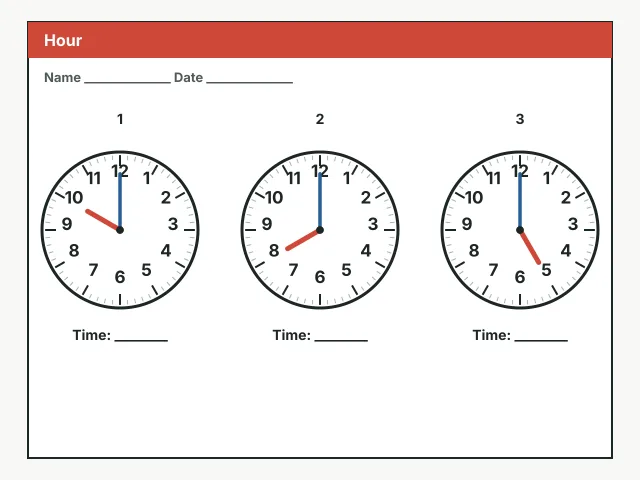
This printable is the first clock worksheet in the set. It has 12 analog clocks, and every one of them shows an o'clock time. The long minute hand points straight up at 12. The short hour hand points at a number from 1 to 12. Under each clock, the child writes the digital time, such as 4:00 or 11:00. There are no half-past, quarter-hour, or single-minute clocks on this page.
A name line and a date line sit at the top of the sheet. The answer key is printed after the 12 questions, so a parent or teacher can check the work on the same page. Download the PDF to save or print that fixed copy. The file is free, and the site does not ask for an email or an account. On the website, Print worksheet prints the set currently on the screen. New questions builds another set of o'clock times in the browser. The PDF does not change, which makes it the copy to hand out when everyone should have the same clocks.
Use this page when a child can find the short hand but still needs practice writing o'clock times. When those answers come easily, go to the hour and half hour worksheet, where the minute hand also stops on 6.
This printable is for children who are learning to write o'clock times. Each clock shows an exact hour, so they can practice matching the short hand to a digital time like 4:00 before they move on to half past. It is best for learners who are connecting the short hand with a written o'clock time.
Review that the long hand on 12 means o'clock, and the short hand tells the hour.
Ask learners to say the hour aloud before writing the digital answer.
Use the answer key, then move to half past when every o'clock time is steady.
Write the time shown on each clock.