Before printing
Review that a.m. comes before noon and p.m. comes after noon.
Use everyday routines to decide whether a time is in the morning, afternoon, or night.
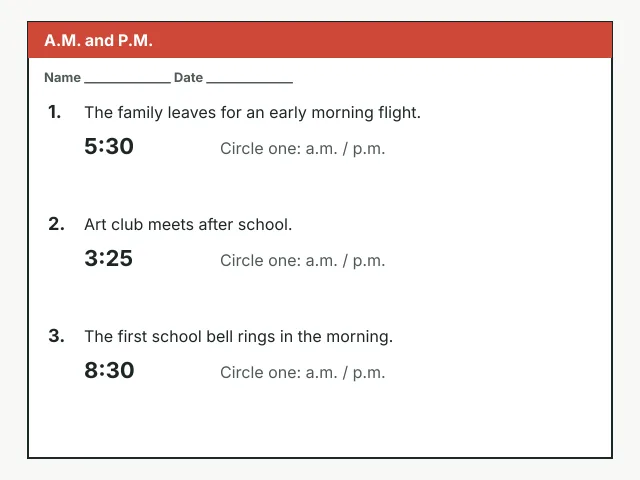
This worksheet does not ask children to read clock hands. It has 12 short events from a day, and each event is printed with a digital time. The child circles a.m. or p.m. The event is the clue, because the same hour can happen in the morning or at night. Every set of 12 includes both a.m. and p.m., since there are not enough events of only one kind to fill the page. The prompts are everyday routines such as breakfast, school, lunch, practice, dinner, and bedtime.
The sheet has a name line and a date line. The answer key lists each time with a.m. or p.m. Download the PDF for a free copy of the worksheet and the answer key. The site does not ask for a sign-up. Print worksheet prints the events on the screen. New questions chooses another 12 events from the same list in the browser. The PDF stays the unchanged file.
Use this page when a child can already read the digital time and needs to decide which half of the day it belongs to. The page does not ask anyone to draw hands or count minute marks.
This worksheet does not ask anyone to read clock hands. Each line gives a daily event and a digital time; the child circles a.m. or p.m. using what the event usually means (breakfast vs bedtime). The written event matters because the same clock time can happen twice in one day.
Review that a.m. comes before noon and p.m. comes after noon.
Ask what part of the day the event usually happens before choosing.
Spend extra time on 12:00 a.m. for midnight and 12:00 p.m. for noon.
Read each event. Circle a.m. or p.m.